If you want to write a powerful essay conclusion, first, restate your thesis in your own words. Next, summarize the key points, explain why your argument matters, and connect it to broader ideas. Finally, end with a strong thought.
A conclusion is one of the important parts of the essay that will help you wrap up your discussion and reinforce the main points you made. Also, it will help you leave a lasting impression on the readers. A good conclusion is more than just a summary. Moreover, it will provide a final opportunity for you to convey your ideas and leave a lasting impact clearly. As conclusion plays a key role, you should make sure to craft it well when writing your essay. In case you are clueless about how to write a strong conclusion for your essay, read this blog and follow the recommended tips. Here, we have explained how to finish your essay effectively with practical examples.
What is an Essay Conclusion?
The conclusion is the last paragraph of an essay. It brings the main argument together and emphasizes its importance. Usually, a strong conclusion does not just repeat what has already been said. It restates the thesis using different words, summarizes the key points, and highlights why the argument matters. Additionally, it connects the ideas to a broader context and shows the overall value of the work to the readers.
Why is a Conclusion Important for an Essay?
The following are some major reasons why a powerful conclusion is essential for an essay
- A conclusion reinforces the main message by restating the thesis in different words.
- The essay conclusion helps the readers remember the main points by summarizing the arguments clearly.
- The conclusion of an essay demonstrates critical thinking by going beyond a simple summary to highlight the importance of the ideas.
Since an essay conclusion holds several benefits, make sure to craft it effectively. You can get Assignment Help from experts online if it is challenging for you to draft an engaging conclusion for a research paper, essay, dissertation, or thesis.
Steps for Writing a Strong Essay Conclusion
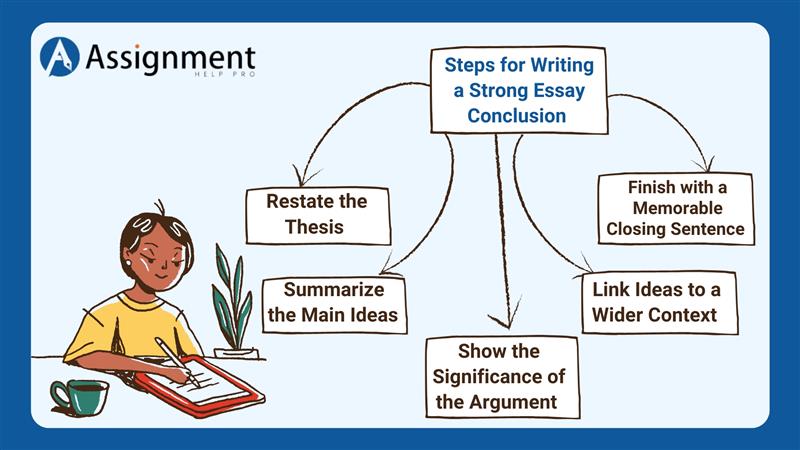
If you want to write a strong conclusion for your essay, then follow these steps
Restate the Thesis
First, strengthen your main argument by rephrasing the thesis statement you wrote at the beginning of your essay instead of copying it exactly.
For example, if your original thesis is “Social media positively influences student learning,” you could restate it as “Social media helps students find resources and communicate more effectively, creating new learning opportunities.”
This approach will make your idea clear and present your thesis statement in new words.
Summarize the Main Ideas
Summarize the key points you have covered in your essay. Make sure to keep your summary short and focus only on the most important points. Avoid including every detail from your essay.
Show the Significance of the Argument
Ask yourself why your argument matters and why the reader should care. In your conclusion, explain how your argument is relevant and what impact it might have.
Link Ideas to a Wider Context
Take your discussion further by connecting your argument to bigger ideas, real-world problems, or possible future research. Specifically, focus on expanding the perspective without adding new evidence. This will help you highlight the wider importance of your argument.
Finish with a Memorable Closing Sentence
Finally, end your conclusion with a statement that sticks in the reader’s mind. You can share a thought, insight, or suggestion that encourages your readers to think more deeply. But make the closing sentence meaningful so your essay leaves a lasting impression. Skip phrases like “In conclusion” unless your teacher asks for them.
Best Ways to Begin a Conclusion Paragraph
How you start a conclusion paragraph will play a key role in setting the tone for your final message and leaving a strong impression on the reader. So, make sure to choose the right conclusion starters for your essay.
Especially, when you begin your conclusion paragraph, avoid using simple phrases like “In conclusion” unless your instructor asks for them. Instead, try using conclusion starter examples such as “Overall, the evidence shows that…,” “These findings highlight the significance of…,” or “Ultimately, this essay demonstrates that….”
These phrases indicate the end of your essay while keeping the writing natural and engaging.
Conclusion Transition Words/Phrases
| Purpose | Conclusion Transition Word/Phrase To Use |
| Summarize | Overall, in summary, in essence, to sum up, in brief |
| Cause & Effect | Therefore, as a result, consequently, thus, for this reason |
| Emphasize Importance | More importantly, undoubtedly, significantly, clearly |
| Final Thought | Ultimately, in closing, finally, to conclude |
| Call to Action | With this in mind, in light of this, let us consider |
By using these techniques, you can make the start of your conclusion clear and engaging. Also, you can set the stage for a strong final statement. Get Thesis Help from experts online if you have doubts about starting a conclusion paragraph.
Structure and Format of a Conclusion Paragraph
A strong conclusion has several key parts that help wrap up your essay effectively. Here is how you should structure your conclusion paragraph
- Restate the central argument in new terms
- Summarize the key points of the essay.
- Highlight a final thought or broader significance.
Simple Outline for an Essay Conclusion
- 1st Sentence: Reword the thesis to reinforce the main argument.
- 2nd and 3rd Sentence: Summarize the key points or arguments discussed in the essay.
- 4th Sentence: Provide a broader perspective or final thought.
Recommended Length of an Essay Conclusion
The length of a conclusion usually varies based on the essay type.
- Short essays (500 – 800 words): 3-4 sentences
- Medium essays (1,000 – 1,500 words): 4-6 sentences
- Long essays or research papers: 1 paragraph (5-7 sentences)
Essay Conclusion Example
Topic: Should school uniforms be mandatory?
Conclusion
School uniforms help create equality among students and reduce peer pressure. They also encourage discipline and foster a sense of school identity. However, some students believe uniforms restrict self-expression and personal style. When combined with opportunities for individuality, uniforms can have a positive impact, but rigid enforcement without flexibility may lead to dissatisfaction.
Here, the first sentence reminds the reader of the main argument. The second sentence summarizes the supporting points. The third sentence explains why the topic matters. Finally, the fourth sentence gives a clear judgment and final thought.
Tips for Writing a Better Essay Conclusion
When you write the conclusion for an essay, follow these tips
Do’s
- Restate your main point using different wording
- Summarize the key arguments or findings briefly
- Emphasize the significance of your topic or argument
- Maintain a tone suitable for your audience and essay purpose
- Conclude with a clear and confident final sentence
- Keep your writing clear and concise
Don’ts
- Repeat the introduction or body paragraphs word for word
- Introduce new arguments, evidence, or examples
- Stray from your original thesis
- Rely on generic or overused expressions
- End abruptly without a proper conclusion
- Include unnecessary explanations or filler content
Final Words
A conclusion is the final part of an essay that reinforces your argument, emphasizes its importance, and leaves a lasting impression. By restating the thesis, summarizing key points, and showing broader relevance, you can create a purposeful closing that makes your essay memorable. If it is challenging for you to write an engaging conclusion, take our Essay Help services. We have skilled essay writers on our team to offer you help with writing an impactful conclusion.
FAQs
1. What should I include in my essay conclusion?
You should restate your main idea, briefly summarize the key points, and finish with a clear sentence showing why your argument is important.
2. How long should my conclusion paragraph be?
Your conclusion should be 3-5 sentences and make up about 10-15% of your essay’s total length.
3. Can I introduce new ideas in my conclusion?
No, you should not introduce new ideas. Instead, you should focus on reinforcing the points you have already discussed.