

Learn to analyze a brand’s strengths, weaknesses, opportunities, and threats with SWOT analysis and create effective marketing campaigns that drive results. This knowledge will help you excel in your marketing assignments and boost your brand’s success. Otherwise, you can get expert marketing assignment help to effectively submit your work on SWOT analysis and campaign planning.
SWOT Analysis (Strengths, Weaknesses, Opportunities, Threats) is fundamental to business strategy and marketing planning. Learn how to conduct and apply SWOT analysis. See our Academic Concepts Guide.
The marketing field is changing fast, and students often have to create detailed strategies and study real businesses for their assignments. Most commonly, for marketing assignments, they will have to deal with the SWOT analysis, along with planning marketing campaigns. But these two tasks test students’ knowledge of marketing ideas and their ability to apply them in real-life situations. As these tasks are complex and data-focused, many students get marketing assignment help from experts to handle them effectively. Instead of approaching subject specialists, you can also read this blog and get a complete understanding of SWOT analysis and campaign planning.
An Overview of SWOT Analysis in Marketing
SWOT stands for Strengths, Weaknesses, Opportunities, and Threats. It is a tool used to look at both the internal factors and external factors that affect a business or marketing project.
Strengths are internal factors that give a company an edge over its competitors. For example, having a strong brand, loyal customers, advanced technology, or a smooth supply chain are some strengths.
Weaknesses are internal problems that can affect a company’s performance. Examples include having a small product range, high prices, or not being well-known in growing markets.
Opportunities are external factors that a company can use to its advantage, like changes in market trends, new laws, or emerging technologies.
Threats are external challenges that could harm the business, such as more competition, shifts in customer preferences, or economic downturns.
As a marketing student, you will often be asked to do a SWOT analysis for a real or fictional business, product, or marketing campaign in your assignments. These tasks are designed to help you develop your analytical skills, strategic thinking, and understanding of the market. If you find it difficult to complete a SWOT analysis, consider getting assignment help from marketing experts online.
Steps to Perform a SWOT Analysis
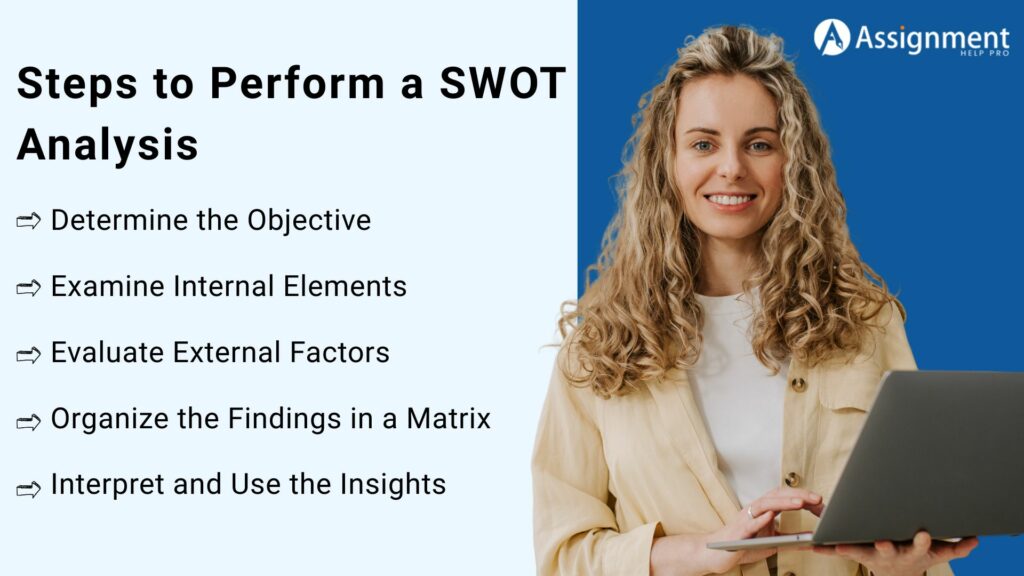
A SWOT analysis is not just about listing random points in four categories. It requires organized thinking, thorough research, and a solid understanding of the business environment. If you are unsure how to do a SWOT analysis for your marketing assignment, follow these steps.
1. Determine the Objective
Before starting, make sure you clearly define the goal of your SWOT analysis. Decide if you are analyzing a company, product, digital marketing plan, or campaign idea. This will help you focus your analysis and set its boundaries.
For example, you could aim to assess Tesla’s current position in the North American market for its electric vehicles.
2. Examine Internal Elements
Once you have set the objective, start looking at internal factors, which are things the company can control, like its own environment. You can gather information from sources such as company reports, financial statements, customer feedback, and employee reviews.
Identify the company’s strengths, like being innovative, having a strong market share, or having effective leadership. Also, note any weaknesses, such as high costs, poor branding, bad customer service, or a weak online presence.
When analyzing these factors, be honest and objective. Avoid just praising or criticizing. Instead, back up each point with real data or examples.
For instance, Apple’s strong brand loyalty is its strength, while its high prices could be considered a weakness.
3. Evaluate External Factors
Next, look at external factors that the company cannot control. To better understand the market, you can use tools like PESTLE analysis, which looks at Political, Economic, Social, Technological, Legal, and Environmental factors.
Look for opportunities, such as new market trends, technologies, or customer groups that the business could tap into. At the same time, identify potential threats, like new competitors, changes in laws, inflation, or falling customer demand, which could impact the company’s success.
For example, a retail brand might benefit from the growth of online shopping but could also face threats from big competitors like Amazon.
4. Organize the Findings in a Matrix
Once you have completed the analysis, arrange your findings into a 2×2 matrix, like the one shown below. This way, it will be easier to spot connections and patterns between the different factors.
| Strengths
Point 1 Point 2 |
Weaknesses
Point 1 Point 2 |
| Opportunities
Point 1 Point 2 |
Threats
Point 1 Point 2 |
5. Interpret and Use the Insights
Finally, analyze your findings and come up with recommendations. Think about how to use your strengths to take advantage of opportunities and address weaknesses to avoid risks. Also, look for ways to use your strengths to counter threats and find opportunities that can help fix weaknesses.
For example, if a company has loyal customers and there is a growing concern for the environment, it could launch a sustainable product line to boost sales.
What is a Marketing Campaign Plan?
A marketing campaign plan is a strategy for promoting a product, service, or brand to a particular group of people. Creating a solid campaign plan is important for reaching your target audience and meeting business goals. In academic assignments, making a campaign plan helps you understand how to use marketing concepts in real-life situations.
How to Build Effective Campaign Plans
If you have no idea how to create a campaign plan, then follow these steps
- Set clear goals for the campaign, like boosting sales or increasing brand awareness.
- Understand your target audience, including their age, interests, habits, and preferences.
- Plan your budget and distribute resources wisely across different parts of the campaign.
- Pick the right marketing channels (social media, email, TV, radio) based on where your audience spends time.
- Craft a strong message and create content or visuals that match your brand and connect with your audience.
- Make a timeline that clearly shows each step of the campaign from start to finish.
- Track performance using metrics like engagement, conversions, and ROI to measure success.
- Review the campaign results and use what you learn to improve plans in the future.
The Importance of SWOT Analysis and Campaign Planning in Digital Marketing
In today’s digital world, some students may doubt the value of traditional tools like SWOT analysis. However, they remain crucial, especially in digital marketing.
For example, even a digital campaign for an e-commerce brand still needs
- A SWOT analysis to identify strengths (e.g., SEO) and threats (e.g., Google algorithm changes).
- A strategic campaign plan for platforms like Google Ads, Facebook, and email.
- Right audience targeting using tools like Facebook Ads Manager and Google Analytics.
- Regular tracking of performance through metrics like CPC, bounce rate, and engagement.
If you want to learn more about this topic, then get digital marketing assignment help from skilled professionals.
Challenges of Marketing Assignments on SWOT Analysis and Campaign Planning
SWOT analysis and campaign planning may seem simple, but many students face these common challenges when preparing marketing assignments on them.
- Lack of real-world experience makes it hard to grasp actual industry situations.
- It is difficult to find accurate, up-to-date data for analysis.
- Applying what is learned in theory to real-life situations is challenging.
- Limited time makes it hard to do thorough research.
- Critical thinking and strategy planning need more than just memorization.
The TOWS Matrix: Turning SWOT Insights Into Campaign Strategy
A SWOT analysis is useless if it sits in a vacuum. To score an A+ on your marketing assignment or to build a winning real-world campaign, you must convert your SWOT findings into an actionable TOWS Matrix strategy. This allows you to match your internal capabilities with external market conditions.
The TOWS Strategic Planning Framework
| Strategy Type | How to Apply It | Example |
|---|---|---|
| SO (Strength-Opportunity) | Use your internal strengths to maximize external opportunities. | Leverage a loyal customer base (S) to launch a new product line (O). |
| ST (Strength-Threat) | Use internal strengths to neutralize or avoid external threats. | Use your high brand equity (S) to lower churn against a new market entrant (T). |
| WO (Weakness-Opportunity) | Improve internal weaknesses by taking advantage of external opportunities. | Partner with a tech vendor (O) to upgrade your outdated CRM systems (W). |
| WT (Weakness-Threat) | Defensive strategy: Minimize weaknesses to avoid external threats. | Liquidate underperforming inventory (W) to survive an economic downturn (T). |
The 4-Step Campaign Planning Workflow
Once you have your TOWS strategy, map your campaign planning through these four professional stages:
- Target Audience Segmentation : Do not target “everyone.” Create detailed Buyer Personas (Demographics, Psychographics, Pain Points, and Digital Behavior).
- Channel Selection & Content Mix : Decide where your strategy lives. Will this be a Paid Social Campaign (Meta/TikTok), Search Engine Marketing (Google Ads), or Content-Led SEO (Blog/Video)?
- Budget Allocation & Creative Assets : Break your campaign budget into Production (Creative design/Video production) and Media Spend (Ad placement/Influencer partnerships).
- KPI Definition & ROI Tracking : Before you launch, define how you measure success. Use SMART Goals (Specific, Measurable, Achievable, Relevant, Time-bound).
Example : “Increase brand conversion rate by 15% through TikTok lead-gen ads within 90 days.”
Wrapping Up
Hopefully, by now, you will have gained knowledge of SWOT analysis and campaign planning. With that knowledge, you can prepare excellent marketing assignments. If you are still doubtful about doing a SWOT analysis and creating campaign plans, then take our marketing assignment help online. The marketing specialists from our team will assist you in effectively completing your assignments on time, boosting your subject comprehension, and achieving top grades.