You can learn 3D animation from scratch with no experience. If you want to master 3D animation, first, study the basics from tutorials or online courses, and then start working on personal projects. By practicing regularly, you can update your animation knowledge and skills and become a pro.
This article has been reviewed and updated with current information, new examples, and the latest academic requirements for 2026
3D animation requires technical skills and creativity. Learn how to master 3D animation from scratch with software, techniques, and practice. Browse our Academic Writing Guides.
Are you interested in 3D animation but feel worried because you have no experience? Don’t worry! You are not alone. In recent times, many beginners have started to explore computer animation. The good news is you do not need any background in art or design to study animation. Simply by following the right plan, using the right tools, and staying motivated, you can learn to create amazing 3D animations. If you are unsure how to go from a beginner to a skilled 3D animator, read this blog. Mainly, to help beginners like you, here, we have shared helpful tips and ways to enhance your animation learning experience.
Understanding the Basics of 3D Animation
Before you start using software or working on projects, you need to understand what 3D animation really means. In simple terms, 3D animation is the process of making objects or characters move in a three-dimensional digital space. Unlike 2D animation, which appears flat, 3D animation includes depth and perspective. This makes the visuals look more realistic and engaging. Today, 3D animation is commonly used in movies, video games, advertisements, and various forms of digital media.
Why Learn 3D Animation?
Nowadays, the demand for skilled 3D animators is growing as immersive content becomes more important in entertainment and marketing. By learning 3D animation, you gain the ability to express your creativity and create dynamic visuals. Moreover, these skills can help you earn through freelance work. No matter whether you want to create animated short films, work in gaming, or design visual effects, by mastering 3D animation, you can open up many creative opportunities.
Tips for Beginners to Learn 3D Animation Effectively
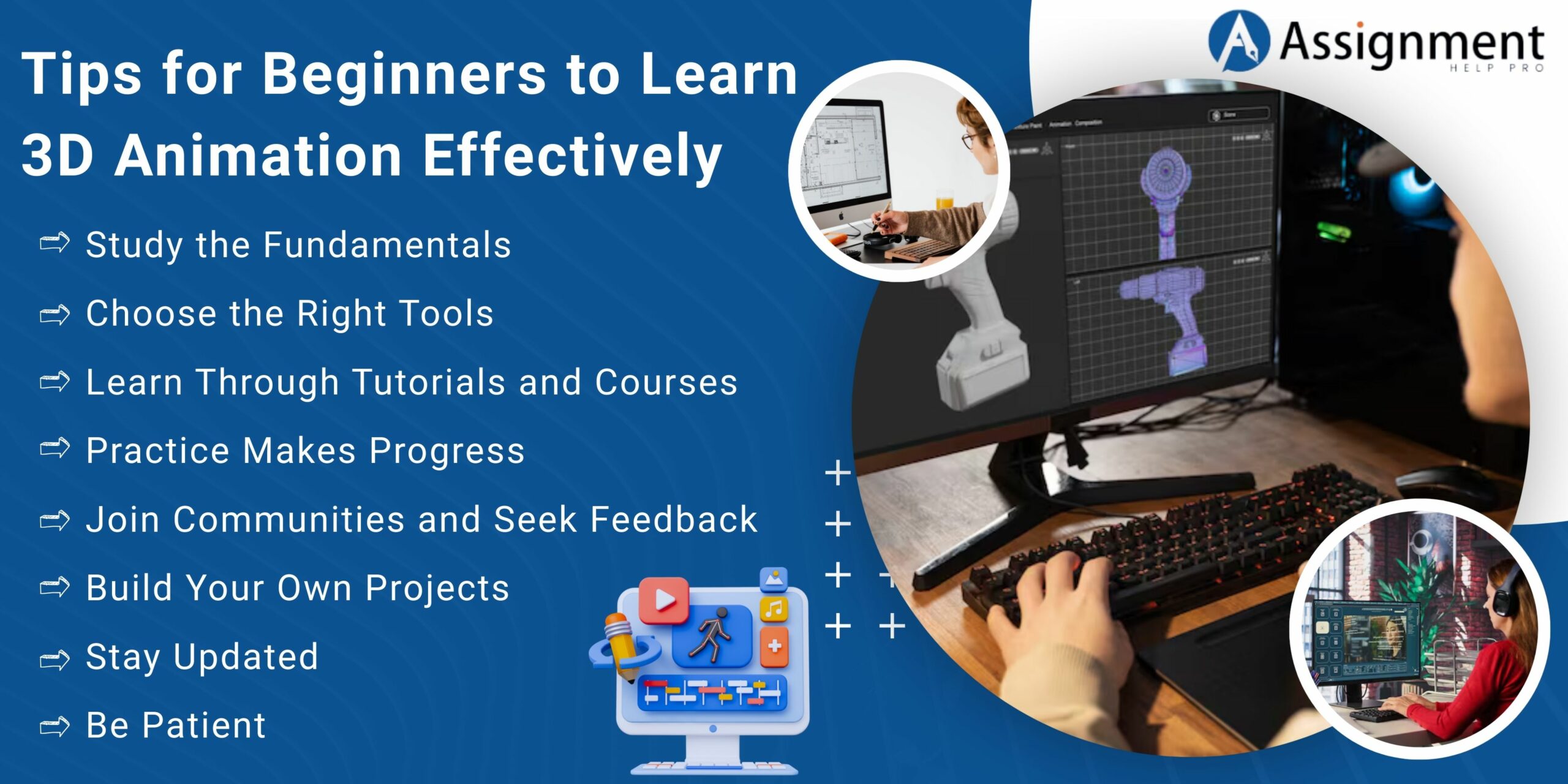
In case you wish to learn 3D animation with no experience, follow these expert-recommended learning tips
Study the Fundamentals
Good animation is not only about looking nice but also about moving realistically. So, first, learn and understand motion and timing by watching how people walk, how animals run, and how objects fall in real life.
Also, learn basic animation principles and processes such as modeling, texturing, rigging, and rendering. Even though these ideas started with 2D animation, they are important for 3D animation as well. When you understand concepts like anticipation, timing, and follow-through, the quality of your animations will improve as you keep learning.
If you want to strengthen your knowledge of animation, utilize the IT Assignment Help services offered by a reputable website. While you use such services, an animation expert will guide you in teaching the important concepts and improving your subject comprehension.
Choose the Right Tools
The right software is essential for transforming creative ideas into finished projects. Hence, based on your project requirements and learning needs, choose an appropriate tool. Blender is powerful and free open-source software that works well for both beginners and professionals. You can use it for modeling, animation, lighting, and rendering all in one place.
Autodesk Maya is another popular program that suits well for professional film and game studios. It is a very advanced tool that requires a paid license. There are other programs you can try, like Cinema 4D or simpler apps with lighter or mobile-friendly designs. These can make learning easier when you are just starting.
But when you begin with a free tool like Blender, you can practice and learn at your own speed without worrying about cost.
Learn Through Tutorials and Courses
There are many online animation tutorials and courses made especially for beginners. Specifically, you can find helpful videos on YouTube that explain everything from basic skills to more advanced techniques in a clear way. These videos will be easy to follow and great for learning step by step.
Additionally, you can also use learning platforms like Udemy, Coursera, and LinkedIn learning that offer structured courses. Mostly, these courses will break animation ideas into small, simple lessons that are easier to understand. If needed, you can also take Animation Assignment Help or online class help services offered by experienced animators to enhance your subject knowledge.
But when you follow a tutorial, first, copy the project exactly as shown. After that, try changing parts of it. This will help you learn better and understand how the tools really work.
Practice Makes Progress
Consistency matters when you learn animation. Initially, start with small goals, such as animating a bouncing ball or a simple walk cycle. Especially by working on these simple projects, you can build confidence before moving on to harder scenes.
Most importantly, you should practice regularly to develop familiarity with the software. Over time, this steady practice will strengthen your animation skills. However, when you focus on any animation project, never be afraid to try things that do not work.
Experiment with various animation techniques and explore different styles. Also, never shy away from committing mistakes. Making mistakes is a normal and important part of learning.
Join Communities and Seek Feedback
Learning works better when it is not done alone. So, try to join online communities focused on animation. Usually, these groups will let you share your work and see what others are creating. Also, you will get more ideas, valuable feedback, and support from these spaces.
When you join a community, you can learn new animation techniques more easily. Furthermore, being active in online communities will help you receive advice, inspiration, and support from people of all skill levels.
Build Your Own Projects
Once you feel comfortable with the basics, begin working on your own creative animation project ideas. Note that your animation projects can be short animated clips, simple walk cycles, or any idea that feels exciting.
Usually, working on your own animation projects will help you use what you have learned. As a result, you can improve your skills and get better practical experience. Also, you can learn from mistakes along the way and become a better animator.
Stay Updated
The world of 3D animation is always changing, with new tools, techniques, and trends appearing all the time. So, stay updated by following blogs, joining online communities, and taking part in workshops.
Being adaptable is very important in this fast-moving field. Therefore, when learning animation, try to stay curious, be flexible, and get to know about new things as you go.
Be Patient
Learning 3D animation can be challenging and full of setbacks. So, be patient and keep going, even when things don’t work out at first.
Remember that mastering animation takes time, just like big achievements in life. Hence, you should stay focused on your goals and celebrate small successes along the way. Every mistake or difficulty is a chance to learn and get better.
Final Words
Learning 3D animation is possible even without any prior experience. Simply with curiosity, persistence, and a clear plan, you can go from a complete beginner to someone who can create impressive animations. If you want to master 3D animation, follow the tips recommended in this blog. By learning step by step, you can improve your animation skills and open up several creative opportunities. In case the tips suggested here didn’t work for you, take our Assignment Help services. The experienced animators from our team will teach you the important animation concepts and help you enhance your knowledge and skills.