In 2026, high school students should learn AI skills like Python, data handling, machine learning, prompt writing, and AI ethics. These skills help them think creatively, solve problems, and prepare for future careers in technology, healthcare, finance, design, and more.
This article has been reviewed and updated with current information, new examples, and the latest academic requirements for 2026
AI is transforming every industry. Learn which AI skills will be most valuable in 2026 and how students can start building them now. Explore our Student Resources.
Artificial Intelligence (AI) is no longer something that is only for tech-savvy people. It has become a part of your life. When your favorite music app recommends songs to you, when a chatbot responds to your questions on the internet, or when software generates art for you, that is AI at work. As AI advances, knowing basic AI skills can give you a huge edge. These skills can help you in your future endeavors and also enable you to tackle real-life problems smartly. In the years to come, knowledge about AI may become as essential as learning to write an essay or solve a math problem. Are you a high school student wondering what AI skills to learn in 2026? If yes, read this blog. Here, we have shared a list of the top AI skills every high school student and beginner must possess.
Why Students Must Learn AI Skills in High School?
Today, AI is becoming a part of everyday life. From the apps you use to learn to the devices you use at home, AI is changing how we live and work. Therefore, high school is the perfect time to start learning AI skills and understand how this technology works.
When you learn AI, you gain valuable knowledge and important life skills. Here is why learning AI skills in high school is important:
- AI is transforming industries like medicine, finance, education, marketing, engineering, and entertainment. Hence, learning AI early will provide you with better career opportunities.
- AI will teach you how to analyze data, find patterns, and solve problems step by step. As a result, you can strengthen your critical thinking.
- Understanding AI will help you see how data is collected and used, so you can make smarter decisions.
- With the help of AI tools, you can create apps, design games, and build solutions for real-world problems.
- AI education will teach responsibility, ethics, and fairness, so you can become a responsible digital citizen.
- Learning AI will build your confidence in using new technologies and make future learning easier.
Top AI Skills High School Students Should Learn
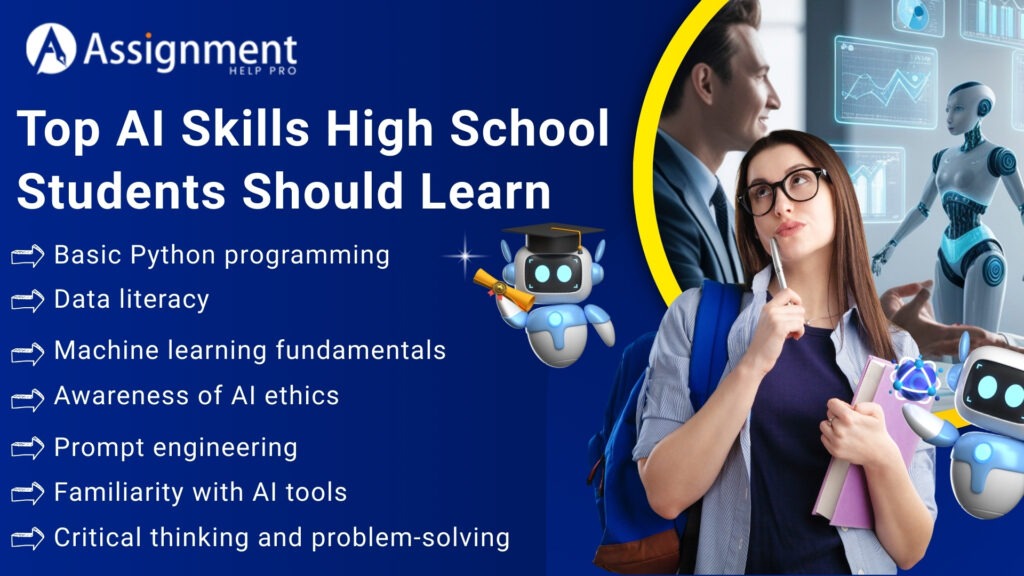
Learning AI does not mean you have to build a robot or create the next ChatGPT on your own. Rather, you should focus on understanding a few important ideas and basic skills that will help you in the future. The following are some essential AI skills that will prepare you for a world where technology plays a big role
1. Basic Python programming
Coding is one of the most valuable skills you should learn in today’s AI-based world. Specifically, you should learn Python. It is easy to comprehend and also has many libraries, such as TensorFlow, Scikit-learn, and NumPy, useful for AI-related tasks.
Generally, to learn Python programming, you can explore lessons on Khan Academy or watch free YouTube tutorials. If you are a beginner, you can try tools like Scratch or Thonny. In case you struggle with coding tasks, you can approach programming assignment help websites and get immediate assistance from experts online.
2. Data literacy
Data literacy is the ability to understand the types of data used in AI systems and to interpret, clean, and display the data. It is also an important skill that you need to acquire if you have to work with AI.
First, you need to learn about datasets and how to spot outliers. Next, you should learn about basic visualization tools such as bar charts and pie charts. Additionally, you can work with actual datasets using platforms such as Kaggle or Google Colab, or using Python libraries such as Pandas and Matplotlib. For data organization and analysis, you should be aware of useful tools such as Google Sheets and Excel. Ultimately, data literacy is all about telling a story with data.
3. Machine learning fundamentals
After you become comfortable with coding and working with data, the next level is Machine Learning (ML), a subset of AI that helps machines learn from data.
First, start with basic tools such as Google’s Teachable Machine, which allows you to create models without coding. Then, once you are familiar with the concepts, learn to develop basic models of ML using Scikit-learn or TensorFlow.
Initially, topics like regression, classification, and clustering may seem difficult. Therefore, you may take computer engineering assignment help services from experts to better understand how algorithms work and connect with hardware and system performance.
4. Awareness of AI ethics
Also, you must have knowledge of how AI functions in the real world. Sometimes, AI may learn human biases concerning race, gender, or culture. Thus, you must learn how to identify and mitigate such biases.
For instance, you can engage in class discussions, view documentaries such as Coded Bias, or listen to TED Talks on AI ethics. Furthermore, many institutions now teach lessons on ethical AI. As you acquire skills on how to develop AI tools or systems, you must also consider the aspects of justice and human rights.
5. Prompt engineering
Prompt engineering is an emerging but valuable skill that refers to crafting well-structured and optimal prompts to achieve the desired outcome from AI tools such as ChatGPT or other generative models. It is not only about asking a question, but it is also about how you ask the question.
AI systems respond differently to each prompt. Therefore, you should experiment with different approaches, such as structured, creative, or instructional writing prompts. Generally, learning how to write prompts will help you develop your problem-solving and communication skills. It will also enable you to achieve better outcomes from AI-powered learning tools. This is because an optimally designed prompt can make a huge difference in the answers you get.
6. Familiarity with AI tools
Hands-on experience with AI tools is very important. Hence, you should explore AI beyond games and try text, image, and video tools.
For example, you can use image generators like Midjourney, video editors such as RunwayML, and no-code platforms like Pictory, Canva AI, or Lobe. Usually, AI is a great helper for creative learners. It will allow you to create art, music, short films, and even ads. By learning how to work with these applications, you can prepare for your future in design, marketing, and communication roles that involve AI.
7. Critical thinking and problem-solving
Generally, AI systems will assist you in solving problems, but you have to review their results, identify mistakes, and be aware of bias. So, you must possess good critical thinking and problem-solving skills
If you want to improve these abilities, you should do classroom assignments, AI-assisted research projects, and brainstorming sessions. Additionally, you can participate in AI competitions or Science Fairs and improve your comprehension of how to solve real-world problems by applying ML concepts.
How to Learn AI Skills
It might be challenging to learn AI skills, but you can begin with small steps and work your way up. Especially when you are curious, you can learn coding, data, and machine learning skills using beginner-friendly resources.
- Take introductory courses on Python, data science, and machine learning on Khan Academy, Coursera, edX, or YouTube.
- Experiment with tools like Teachable Machine, Scratch, or Google Colab to practice hands-on projects.
- Join school tech clubs, participate in AI challenges, or try virtual coding bootcamps for experience.
- Work at your own pace and remain consistent, curious, and open to making mistakes to learn and improve.
Conclusion
Learning AI is more than just acquiring technical knowledge. High school is the best time for you to begin exploring, experimenting, and learning a solid foundation in essential AI skills. Whether you plan to become a developer, designer, doctor, or entrepreneur, chances are that AI will feature in your plans. If you require expert guidance to improve your AI skills, take our online assignment help services. The professionals from our team will assist you in developing the skills necessary to start your career in AI.