


In modern nursing and healthcare practice, clinical safety relies on the ability to make rapid, accurate, and evidence-based decisions. Research shows that poor clinical reasoning is a primary contributing factor in failure to rescue (FTR) and adverse patient outcomes during acute clinical deterioration.
To standardize and improve healthcare decision-making, Professor Tracy Levett-Jones and her colleagues at the University of Newcastle developed the Clinical Reasoning Cycle (CRC). This 8-step framework guides nurses and medical professionals through a systematic, cognitive process—moving from initial patient assessment to evaluating care outcomes and reflective practice.
Whether you are a nursing student writing a clinical case study assignment, preparing for OSCE clinical exams, or a practicing registered nurse refining your diagnostic accuracy, understanding how to apply the CRC is essential.
In this comprehensive guide, we break down all 8 steps of the Clinical Reasoning Cycle, provide a complete real-world case study example, and highlight common cognitive errors to avoid in healthcare settings.

What is Clinical Reasoning?
Clinical Thinking is the mental cycle utilized by clinicians, attendants, and other medical services experts in examining a patient’s condition and finding a precise conclusion and therapy plan.
To put it in simple terms, clinical reasoning is the ability of a clinician or nurse to effectively assess a patient’s health condition and initiate the appropriate course of action by utilizing their clinical knowledge of the local culture and medical ethics. Clinical reasoning and terms like critical thinking, clinical judgment, problem-solving, and decision-making have sometimes been used interchangeably.
What is Clinical Reasoning in Nursing? (System 1 vs. System 2 Thinking)
Clinical reasoning is the complex cognitive process by which healthcare professionals collect cues, process information, come to an understanding of a patient problem or situation, plan and implement interventions, evaluate outcomes, and reflect on and learn from the process.
In cognitive psychology and healthcare education, clinical reasoning is governed by Dual-Process Theory, which involves two distinct modes of thinking:
- System 1 (Heuristic / Intuitive Reasoning) : Fast, automatic, and pattern-recognition-based thinking. Experienced nurses use System 1 to instantly recognize a deteriorating patient based on subtle visual and physiological cues (e.g., recognizing “septic shock” upon seeing a mottled, hypotensive patient).
- System 2 (Analytical / Systematic Reasoning) : Slow, deliberate, and step-by-step critical analysis. Novice nurses and students rely heavily on System 2—using structured frameworks like the Levett-Jones Clinical Reasoning Cycle —to systematically analyze vital signs, laboratory results, and pathophysiology without missing critical data.
Why is the Clinical Reasoning Cycle Essential?
Applying a structured reasoning cycle prevents diagnostic overshadowing and premature closure—cognitive biases where a nurse or doctor focuses on an obvious symptom while ignoring critical background cues, leading to misdiagnosis or delayed treatment.
Benefits of Clinical Reasoning
Sometimes, poor clinical reasoning skills can put a patient’s health or even death in jeopardy. Therefore, every healthcare professional needs to be well-versed in the clinical reasoning cycle.
Clinical reasoning generally has many advantages. Let’s now examine the significance of clinical reasoning.
If you have good clinical reasoning skills, then you can
- Make an accurate diagnosis.
- Improve the health of the patients.
- Make prompt life-saving treatment plans.
- Reduce the patient’s medical expenses by avoiding unnecessary medical examinations.
What is meant by the Clinical Reasoning Cycle?
An educational model called the Clinical Reasoning Cycle was created specifically for nursing students. The ultimate goal of this model is to educate students and equip them with the skills they need to care for critically ill patients.
In 2009, Levett-Jones described the clinical reasoning cycle. There are eight stages to his proposed clinical reasoning cycle. Healthcare professionals can use this cycle to go through a series of systematic phases and arrive at a decision that is best for patients.
The 8 Steps of Levett-Jones’ Clinical Reasoning Cycle Explained
The Clinical Reasoning Cycle is represented as a continuous, clockwise circular loop. However, in emergency clinical environments, nurses frequently move back and forth between steps as new patient data emerges.
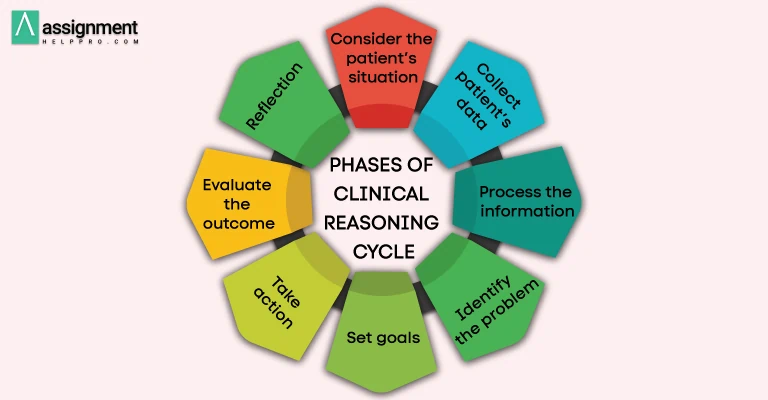
Step 1: Consider the Patient Situation
This initial phase involves gathering the baseline clinical context before or immediately upon meeting the patient.
- Clinical Actions : Receive handover report, review the patient’s medical chart, check admission records, and understand the primary medical diagnosis.
- Questions to Ask : Who is this patient? What is their age, gender, and primary reason for admission? What are their pre-existing comorbidities and resuscitation status (e.g., DNR/NFR)?
- Example : Receiving handover for Mr. Arthur Pendelton, a 72-year-old male admitted 12 hours ago with a right lower lobe pneumonia and a history of Type 2 Diabetes and COPD.
Step 2: Collect Cues and Information
In this phase, you systematically gather both subjective data (what the patient reports) and objective data (what you observe and measure) using health assessment tools.
- Clinical Actions:
- Review current information : Vital signs, EKG, blood laboratory results (e.g., ABGs, WBC, electrolytes), and medication charts.
- Gather new information : Perform a physical assessment using the A-G (Airway to Glucose) or ABCDE approach, conduct a pain assessment (PQRST), and ask targeted patient history questions.
- Recall nursing knowledge : Connect clinical cues to pharmacology, anatomy, and pathophysiology.
- Example : Arthur is sweating and lethargic. His respiratory rate is 28 breaths/min (tachypnea), oxygen saturation is 88% on room air, temperature is 38.9°C (fever), blood pressure is 90/55 mmHg (hypotension), and heart rate is 115 bpm (tachycardia).
Step 3: Process the Information
This is the most critical cognitive phase where you analyze and interpret the collected data to distinguish between normal variations and acute pathophysiological abnormalities.
- Clinical Actions :
- Interpret : Identify abnormal physiological values (e.g., recognizing that a BP of 90/55 indicates hemodynamic instability).
- Discriminate : Distinguish relevant clinical cues from irrelevant ones. Focus on life-threatening signs first.
- Relate : Group related cues together to identify clinical patterns (e.g., fever + tachycardia + tachypnea + hypotension = systemic infection response).
- Infer : Formulate preliminary hypotheses regarding what is happening physiologically within the patient’s body.
- Match : Compare the current patient presentation against known clinical disease patterns or previous patient encounters.
- Predict : Anticipate potential clinical complications if immediate intervention is not taken (e.g., predicting progression to septic shock and multi-organ failure).
Step 4: Identify Problems and Issues
Based on your synthesized data processing, you now formulate a definitive nursing diagnosis or identify the primary clinical problem requiring intervention.
- Clinical Actions : Synthesize all physiological cues to state the underlying clinical problem clearly. Differentiate between actual current problems and potential/high-risk problems.
- Example : Arthur is experiencing acute respiratory distress and early hemodynamic collapse secondary to severe sepsis caused by his underlying right lower lobe pneumonia.
Step 5: Establish Goals
Before executing clinical tasks, you must define SMART (Specific, Measurable, Achievable, Relevant, Time-bound) clinical goals in collaboration with the patient and multidisciplinary team.
- Clinical Actions : Establish both immediate short-term resuscitation goals and long-term recovery goals.
- Example Short-Term Goal : Increase oxygen saturation (SpO2) to ≥ 94% within 15 minutes and restore Mean Arterial Pressure (MAP) to ≥ 65 mmHg within 1 hour.
Step 6: Take Action / Select Interventions
You now select and execute evidence-based nursing interventions designed to achieve the established clinical goals.
- Clinical Actions:
- Independent Nursing Actions: Position the patient in high-Fowler’s position, initiate continuous cardiac/O2 monitoring, and perform peripheral intravenous cannulation (if within practice scope).
- Collaborative/Dependent Actions: Administer prescribed supplemental oxygen via HUDSON mask or nasal cannula, immediately escalate clinical deterioration via the ISBAR (Identify, Situation, Background, Assessment, Recommendation) protocol to the Medical Emergency Team (MET), and administer stat IV fluid boluses and broad-spectrum IV antibiotics as ordered by the physician.
Step 7: Evaluate Outcomes
After implementing clinical interventions, you must continuously re-assess the patient to determine whether the actions were effective in stabilizing their condition.
- Clinical Actions: Re-take vital signs, re-assess the patient’s level of consciousness (GCS or AVPU scale), check urine output, and review follow-up arterial blood gas (ABG) results.
- Example: 30 minutes post-intervention, Arthur’s SpO2 has improved to 95% on 4L/min oxygen, HR has decreased to 96 bpm, and BP has stabilized at 110/70 mmHg. The clinical deterioration has been successfully mitigated.
Step 8: Reflect on the Process and New Learning
The final step occurs after the clinical event has concluded. Critical reflection transforms everyday clinical experience into expert nursing intuition.
- Clinical Actions : Engage in self-reflection or formal clinical debriefing using models like Gibbs’ Reflective Cycle or Johns’ Model of Reflection.
- Questions to Ask : What happened? What did I do well during the resuscitation? What could I have done faster or differently? What knowledge gaps did this scenario reveal, and what will I do next time I encounter a similar patient presentation?
Practical Case Study: Applying the Clinical Reasoning Cycle in Nursing
To help you structure your nursing care plan or clinical assignment, here is a complete, step-by-step application of the Levett-Jones CRC using an acute clinical scenario.
| CRC Step | Clinical Scenario Application (Patient: Mrs. Eleanor Vance, 68 Years Old) |
|---|---|
| 1. Consider Situation | 68-year-old female, 2 days post-op following a total right hip replacement (arthroplasty). Medical history of hypertension and osteoarthritis. Has a PCA (Patient-Controlled Analgesia) morphine pump and an indwelling urinary catheter (IDC). |
| 2. Collect Cues | Objective:
Subjective:
|
| 3. Process Information | Interpret & Match:Pinpoint pupils, severe bradypnea (RR 8), lethargy, and recent high morphine PCA usage match the classic clinical triad of acute opioid toxicity / respiratory depression.
Predict: Without immediate pharmacological reversal and airway support, the patient may progress to respiratory arrest, severe hypoxia, and anoxic brain injury. |
| 4. Identify Problems | Primary Actual Problem:Acute opioid-induced respiratory depression and severe hypoxemia secondary to PCA morphine overdose.
Secondary Potential Problem: High risk of airway compromise and aspiration due to altered level of consciousness. |
| 5. Establish Goals |
|
| 6. Take Action |
|
| 7. Evaluate Outcomes | Five minutes after IV Naloxone administration:
|
| 8. Reflect & Learn | Reflection:Prompt recognition of the respiratory depression triad prevented a fatal cardiac arrest. However, on reviewing the chart, I realised the patient’s sedation scores had been gradually increasing over the previous two hourly assessments without clinical escalation.
New Learning: In future post-operative assessments, I will strictly adhere to the sedation scoring escalation protocol and advocate for multimodal opioid-sparing analgesia in older adults with decreased renal clearance. |
4 Common Cognitive Pitfalls in Clinical Reasoning (And How to Avoid Them)
Research indicates that diagnostic errors in nursing are rarely due to technical incompetence; instead, they stem from cognitive biases during Step 3 (Processing Information) and Step 4 (Identifying Problems). Be sure to address these pitfalls in your clinical research papers:
1. Anchoring Bias (Premature Closure)
- What it is : Locking onto the first obvious clinical cue or preliminary diagnosis while ignoring subsequent data that contradicts it.
- Clinical Example : A patient admitted with a history of anxiety presents with chest pain and shortness of breath. The nurse anchors onto the “anxiety” history and dismisses the symptoms as a panic attack, missing an evolution of an Acute Myocardial Infarction (STEMI).
- Prevention : Always ask yourself: “What else could this be? What is the most dangerous diagnosis that I must rule out first?”
2. Confirmation Bias
- What it is : Seeking out or overvaluing clinical cues that confirm your pre-existing hypothesis while discounting data that points to an alternative problem.
- Clinical Example : Expecting a post-operative fever to be caused by a simple wound infection, a nurse ignores complaints of calf pain and swelling—missing a life-threatening Deep Vein Thrombosis (DVT) progressing to a Pulmonary Embolism (PE).
- Prevention : Actively search for disconfirming evidence before finalizing your nursing diagnosis in Step 4.
3. Diagnostic Overshadowing
- What it is : Attributing a patient’s physical symptoms to their pre-existing mental health condition, neurodevelopmental disorder, or chronic disability rather than conducting a thorough physical assessment.
- Clinical Example : Assuming an elderly patient with Alzheimer’s disease who is screaming and agitated is simply experiencing dementia-related behavioral decline, when in reality they are in severe delirium caused by acute urinary retention or sepsis.
- Prevention : Perform a baseline head-to-toe physical assessment (Step 2) on every patient, regardless of cognitive or psychiatric history.
4. Normalization of Deviance
- What it is : Gradually accepting abnormal clinical signs or shortcuts as “acceptable” because no immediate patient harm occurred in previous instances.
- Clinical Example : Routinely failing to escalate a patient’s early Early Warning Score (EWS / MEWS) because “their blood pressure is always a bit low,” leading to a delayed resuscitation call when systemic shock sets in.
- Prevention : Strictly adhere to institutional vital sign escalation protocols and objective clinical scoring criteria during Step 6.
Conclusion
We hope you have now gained a better understanding of the major steps involved in the clinical reasoning cycle. If you are a medical or nursing student, then during your course duration, your professors may ask you to submit assignments on the clinical reasoning cycle to improve your skills. In case you experience any difficulties with writing your medical and nursing assignments on clinical reasoning, contact us immediately. We will offer you the best nursing assignment help as per your needs so you can complete your work on time and secure top grades.



: 8 Steps, Case Study & Care Plan Guide)