


In academic writing, research papers, and English proficiency exams (such as IELTS, TOEFL, and PTE), ideas are only as strong as the structure connecting them. Linking words—also known as transition words, cohesive devices, or discourse markers—act as the structural bridges between your sentences and paragraphs.
In fact, in standardized writing assessments, Coherence and Cohesion account for exactly 25% of your total band score. Yet, one of the most common reasons students lose grades is not a lack of vocabulary, but the grammatical misuse of linking words—such as comma splices, sentence fragments, and using informal spoken transitions in formal theses.
To help you write with flawless flow and academic rigor, our language experts and thesis editors have compiled an exhaustive guide to over 200 academic linking words for 2026, categorized by logical function. We also break down essential punctuation formulas and formal-versus-informal distinctions so you can apply them correctly every time.
What are Linking/Transition Words?
Words that connect two sentences are referred to as linking/transition/ connecting words. Using the appropriate linking words is essential if you want to connect ideas without losing their meaning. To get a comprehension of these words, you should refer to the connecting words list. The conjunctions “but,” “and,” “if,” and “or” are some of the most frequently employed linking words. Adverbs, on the other hand, are crucial for connecting ideas and facilitating seamless transitions between them.
Conjunctions and adverbs, on the other hand, help the reader comprehend the message being conveyed by the author or speaker. As a result, it’s critical to comprehend how transition words aid in writing communication’s effectiveness and comprehension. In this blog post, you will find a variety of lists of linking words based on various circumstances and occasions.
What are the Different Types of Linking Words?
It’s tough to form a convincing essay. If you need to make your essay all the more engaging and expressive, at that point center on three things: exploration, introduction, and influence. If you don’t have a skill for writing, at that point you will flop pitiably in framing a firm essay with legal utilization of connecting words.
Linking words play a significant role in an essay. Without transition words, the data introduced in an essay is only a dump of words. If you don’t need your assignment to be awkward and disconnected, use linking words and expressions effectively.
There are different classes of linking words one can utilize while writing an essay. Find here 8 principal classes and transition words to be utilized while creating an essay.
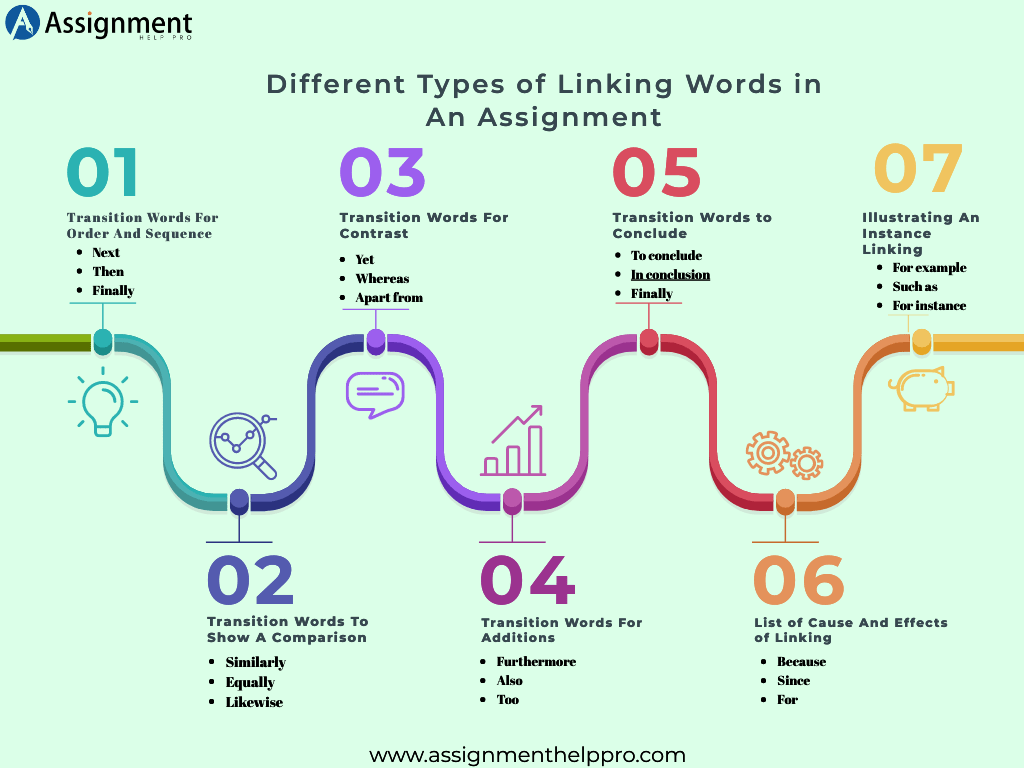
So here are 8 sorts of linking words to be utilized in an essay:
List of Linking/Transition Words For Order And Sequence
Well, flow is a mandatory point for an essay. If there is a lack of the flow of thoughts, musings, or rationale in your essay, it will lose its magnificence. Here is a linking word list that helps by demonstrating an arrangement list in the essay.
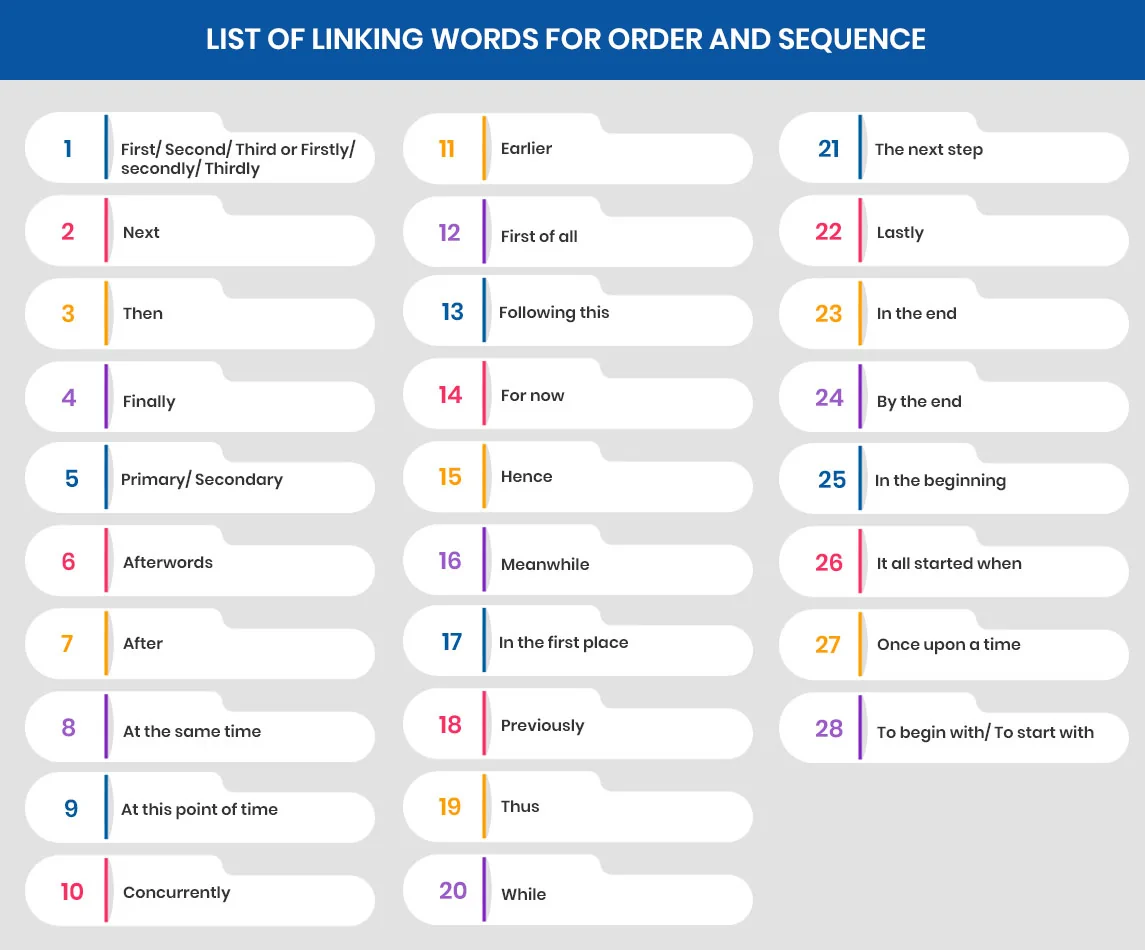
- First/ Second/ Third or Firstly/ secondly/ Thirdly
- Next
- Then
- Finally
- Primary/ Secondary
- Afterwords
- After
- At the same time
- At this point
- Concurrently
- Earlier
- First of all
- Following this
- For now
- Hence
- Meanwhile
- In the first place
- Previously
- Thus
- While
- The next step
- Lastly
- In the end
- By the end
- In the beginning
- It all started when
- Once upon a time
- To begin with,/to start with
List of Transition Words To Show A Comparison
In different kinds of essays, for example, contentious essay writing, and compare & contrast essay writing, you may need to show comparison. In this way, you can follow the accompanying words to make the comparison all the clearer. Here is the list of connecting words to show a comparison:
- Similarly
- Equally
- Likewise
- As with
- Just as … so too
- A similar
- Comparable
- At the same time
- Just as
- Same as
- By the same token
- In the same way
- Just like
List of Linking/Transition Words For Contrast
Much the same as how you need linking words to show comparison, some words are used to show the differentiation too. Here is the list of linking words to show differentiation:
- However/ Nevertheless
- Alternatively
- Despite this
- On the contrary
- Yet
- Whereas
- Apart from
- Even so
- Although
- Despite
- While
Examples of Transition Words
Practically, a wide range of essays require evidence or a few guides to demonstrate a specific point of view. But simply telling a model may sound gruff. That is the reason we use linking words to show models in a beautiful way. View the linking words list:
- For example
- Such as
- For instance
- In other words
- An instance
- As revealed by
- To show that
- In the case of
- As an example
- For one thing
List of Linking/Transition Words For Additions
If you need to include some more info, you can utilize expansion linking words to convey the correct significance. Utilizing “additionally” or “and” wherever in the essay can remove the appeal. So here is the list of linking words you can use while including new info.
- Furthermore
- Also
- Too
- Next
- Secondly
- Second
- And
- Or
- Nor
- First
- Last
- Lastly
- Further
- Again
- In addition
- As well
- Then
- Moreover
- Besides
- Specifically
- To illustrate
- For example
- To demonstrate
- Such as
- For instance
- As revealed by
- Finally
- Along
- By the same token
- Uniquely
- Like
- And all
- In-line manner
- Still
- Likewise
- Along with
- Not only … but also
- What’s more
- Except for
- By the same
Linking/Transition Words for Cause and Effects
Furthermore, if you need to reach a discerning inference, you have to utilize cause-and-effect words. This makes a decent association of the entire essay with an end. Utilize these linking words in an assignment to show the cause-and-effect association.
- Because
- Since
- For
- So
- Consequently
- Therefore
- Thus
- Hence
- Owing to
- As a result of
- Causes
- As a consequence of
- Leads to
- Contributes to
- For this reason
- Stems from
- Comes from
- Results from
- Is the result of
- Is the consequence of
- Is due to
- Is caused by
List of Transition Words to Conclude
A decent essay has a good ending. While the vast majority of the students utilize nearly similar words to finish their essays, here you get the opportunity to close the essay with some great words. Take a gander at the list of linking words for a fantastic end:
- To conclude
- In conclusion
- Finally
- Evidently
- To sum up
- On the whole
- Summarising
- In closing
- All in all
- By and large
- All things considered
- In summary
- In sum
- In brief
- Briefly
- In short
- In outline
- In the long run
- For the most part
- After all
- In essence
- On balance
- Overall
- By the large
- Consequently
- Hence
- So
- Then
- Therefore
- Thus
- As a result
So, we have seen that there are 8 fundamental sorts of connecting word classes that can be utilized while writing an assignment.
But simply utilizing these words isn’t sufficient. You have to alter and situate them accurately, or something bad might happen; they will neglect to entice the readers.
In the following paragraph, I will tell you the best way to utilize these words in sentences.
The 3 Grammatical Types of Linking Words (And How to Punctuate Them)
Before choosing a linking word from the lists below, you must understand its grammatical classification. Using a subordinating conjunction with the punctuation of a transition adverb is a major grammatical error.
1. Transition Adverbs (Conjunctive Adverbs)
These words connect two independent clauses (complete thoughts) or open a new paragraph.
- The Rule : When joining two independent clauses in one sentence, you must use a semicolon (`;`) before the word and a comma (`,`) after it. When starting a new sentence, capitalize the word and follow it with a comma.
- Examples: However, therefore, furthermore, consequently, moreover.
- Correct Formula A: `[Independent Clause] ; therefore , [Independent Clause] .`
- Correct Formula B: `[Independent Clause] . Therefore , [Independent Clause] .`
- Incorrect (Comma Splice): The data was incomplete, therefore the study was repeated.
2. Coordinating Conjunctions (FANBOYS)
These words connect words, phrases, or independent clauses of equal grammatical rank.
- The Rule: Remember the acronym FANBOYS (For, And, Nor, But, Or, Yet, So). When connecting two complete sentences, place a comma before the conjunction—never after it.
- Correct Formula: `[Independent Clause] , but [Independent Clause] .`
- Example: The survey sample was small, yet the results showed a statistically significant trend.
3. Subordinating Conjunctions
These words introduce a dependent clause and establish a relationship of time, cause, or condition with an independent clause.
- The Rule : If the subordinating word starts the sentence, place a comma at the end of the dependent clause. If it appears in the middle of the sentence, do not use a comma.
- Examples: Although, because, since, whereas, while, unless.
- Correct Formula A (Start): `Although [Dependent Clause] , [Independent Clause] .`
- Correct Formula B (Middle):`[Independent Clause] although [Dependent Clause] .`
How to Use Linking Words in an Assignment?
Utilizing connecting words effectively in an essay isn’t very difficult. You can learn it effectively; all you need is concentration while writing an essay. There are three different ways, or I should state positions, where you can accommodate your linking words.
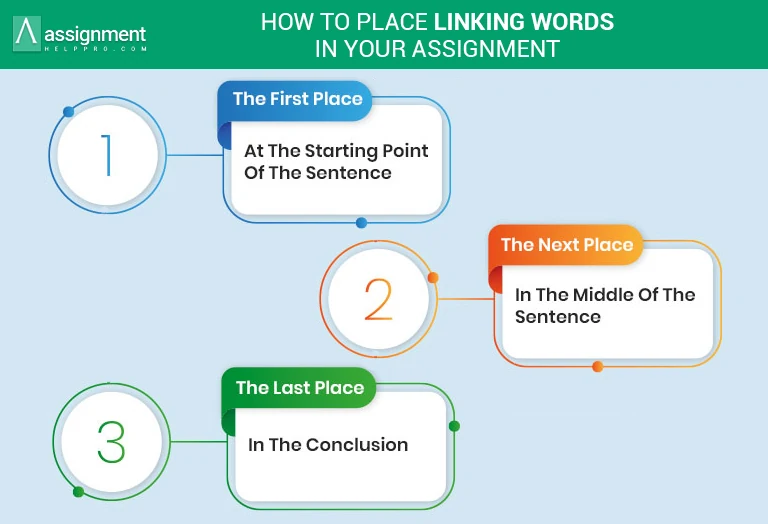
At the starting point of a sentence
You can begin a sentence alongside a connecting word that gives a reference to the last point. View a few instances to understand.
- One can have a ton of difficulty in writing innovatively. But expert writing is a valuable aptitude.
- I am not a major aficionado of wonder funnies. On the other hand, I like their idea.
- I bumble a great deal while talking. Subsequently, I neglected to clear meetings.
In the middle of a sentence
In an assignment, you can utilize transition words in the sentences, too. For the most part, we write it after the subject. Figure out how to use it through the accompanying models.
- One can’t escape disappointment. They are, in any case, great exercises in life.
- I am bad at language structure; thus, I fail to get passing marks in scholastic assignments.
- The right data is required for a decent essay, but thoughts also play a significant role.
At the conclusion
Hence, you can utilize the association or linking words at the end of the essay. It bodes well; you can see that in the accompanying sentences.
- Learning grammatical guidelines is a difficult process. It is very beneficial, but.
- I am not a poetry lover. I love to rehearse them, on the other hand.
- I’m not a confident individual. I get nervous in public, as a result.
Complete List of Academic Linking Words by Logical Function
1. Linking Words for Addition & Agreement
Use these cohesive devices to add supplementary evidence, reinforce an existing argument, or introduce parallel ideas.
- Furthermore (e.g., Furthermore, the algorithm reduces processing time by 40%.)
- Moreover (Indicates an even more significant addition)
- In addition to [noun/gerund]
- Additionally
- Not only… but also…
- Equally important
- By the same token
- Likewise
- Correspondingly
- To compound this
2. Linking Words for Contrast & Concession
Use these to introduce counter-arguments, highlight opposing data, or acknowledge limitations in research.
- However (The most versatile transition for contrast)
- Nevertheless / Nonetheless (Highly formal; used to state a fact despite preceding evidence)
- Conversely (Used when presenting an opposite idea or inverse relationship)
- In contrast / By contrast
- On the contrary (Used to directly contradict a previous statement)
- Whereas / While (Subordinators used for direct side-by-side comparison)
- Despite / In spite of [noun/gerund] (Never follow these with “of the fact that” or a full verb clause)
- Albeit (Formal synonym for “although”; usually followed by an adjective or phrase, not a full clause)
- Admittedly
- Notwithstanding
3. Linking Words for Cause, Effect & Result
Essential for methodology and analytical sections where you must demonstrate causality and logical consequences.
- Consequently
- Therefore
- As a result / As a consequence
- Thus / Hence (Often used without a following comma in concise mathematical or scientific proofs)
- Owing to / Due to [noun]
- For this reason
- Stemming from
- In light of [evidence/fact]
- Thereby (Usually followed by an -ing verb: “…thereby increasing overall efficiency.”)
- Accordingly
4. Linking Words for Sequence & Chronology
Use these to organize steps in a research methodology, chronological literature review, or multi-point argument.
- Initially / To begin with
- Subsequently (Formal replacement for “next” or “then”)
- Simultaneously / Concurently (Happening at the exact same time)
- Previously / Retrospectively
- In the first instance
- Proceeding this
- Following this development
- Ultimately / Eventually
- To culminate
5. Linking Words for Illustration & Emphasis
Use these to introduce specific case studies, empirical data points, or emphasize critical findings.
- For instance / For example
- Specifically / To be specific
- To illustrate this
- Notably / Significantly
- In particular / Particularly
- As evidenced by
- A primary example of this is
- Indeed (Used to reinforce and strengthen a previous statement)
- Without a doubt / Unquestionably
6. Linking Words for Summary & Conclusion
Use these strictly in your concluding paragraphs to synthesize arguments and state final verdicts.
- In conclusion / To conclude
- In summary / To summarize
- To synthesize these findings
- Ultimately
- On balance (Used when weighing two opposing sides before giving a verdict)
- All things considered
- In essence
- To reiterate
- Taking everything into account
Academic vs. Informal Linking Words: What to Avoid
One of the quickest ways to lower the register of an academic essay or lose marks in an IELTS/TOEFL exam is using spoken conversational fillers instead of formal discourse markers. Replace the informal words on the left with their academic counterparts on the right:
| Informal / Spoken (Avoid in Essays) | Academic / Formal Counterpart |
|---|---|
| Also / Plus / On top of that | Furthermore / Moreover / Additionally |
| Anyway / Anyhow | Nevertheless / Regardless / Be that as it may |
| So (at the start of a sentence) | Therefore / Consequently / Thus / As a result |
| But (at the start of a sentence) | However / Conversely / Yet / In contrast |
| Because of this | Consequently / Accordingly / Hence |
| In a nutshell / Long story short | In summary / To synthesize / In essence |
| Besides | In addition / Furthermore / Not only… but also |
| Like (for giving examples) | Such as / For instance / As demonstrated by |
| At the end of the day | Ultimately / On balance / When all factors are considered |
4 Fatal Mistakes Students Make With Linking Words
1. Over-linking (The “Transition Trap”)
You do not need a linking word at the start of every single sentence. Over-using transitions makes your writing feel mechanical, robotic, and forced. Use them only when there is a logical shift, contrast, or direct continuation that needs clarification. If the logical flow between two sentences is obvious, let the ideas stand alone.
2. Using “Despite” and “In Spite Of” with a Verb Clause
A very common ESL grammar mistake is writing: “Despite the weather was bad, the experiment continued.”
- The Rule : Despite and in spite of are prepositions; they can only be followed by a noun, a pronoun, or a gerund (-ing word).
- Correct : “Despite the bad weather, the experiment continued.”
- Correct : “In spite of experiencing technical delays, the project finished on time.”
Conclusion
We hope you are now aware of what linking words are and how to use them in your academic writing. In case you are still confused about how to use transition words in your content and improve the flow of narration, approach us immediately for support. Whenever you take our English assignment help services, the experts from our team will assist you in using linking words in your essay.



)